SAPP Technology
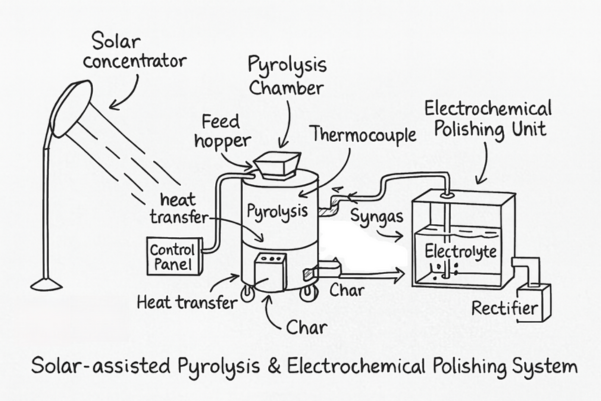
SAPP Technology — Solar-Assisted Pyrolysis & Electrochemical Polishing
A Next-Generation, Off-Grid Sanitation System for Safe, Sustainable, AMR-Resilient Communities
The Challenge We Are Solving
Unsafe faecal sludge and greywater management remains one of the largest yet most overlooked drivers of environmental contamination and infectious disease in India. In most low-resource settings, poorly designed septic tanks, water-dependent flush toilets, open drains, and lack of sewerage networks allow pathogens to leak directly into soil, groundwater, and surface water.
This continuous environmental contamination results in:
- Recurrent diarrhoeal and enteric infections
- Increased antibiotic usage → accelerating antimicrobial resistance (AMR)
- Chronic exposure for women, children, and vulnerable communities
- Ecosystem damage due to untreated organic load & pollutants
Sanitation is not just an infrastructure gap — it is a public health and AMR emergency.
Our Breakthrough Solution: SAPP Technology
SAPP (Solar-Assisted Pyrolysis & Electrochemical Polishing) is Aventiq Innovations’ decentralized, off-grid sanitation platform designed to treat both solid and liquid waste at the source, eliminating the need for electricity, water-intensive flushing systems, or centralized sewage infrastructure. It is engineered to deliver zero-pathogen, zero-energy, zero-contamination sanitation, making it ideal for rural, peri-urban, disaster-prone, and underserved communities.
Core Technological Innovations
☀️ Solar-Assisted Low-Oxygen Pyrolysis of Faecal Sludge
- Achieves >90% pathogen inactivation (near complete sterilization)
- Generates value-added biochar with carbon-rich content
- Biochar is pathogen-free and environmentally safe soil amendment potential
- Eliminates odour, vector breeding, and pathogen seepage
💧 Membrane-Assisted Electrochemical Polishing of Greywater
- Removes bacteria, viruses, organic load, colour, and odour
- Uses advanced oxidation electrocoagulation in a maintenance-light design
- No chemicals – no sludge – long life cycle
- Produces safe, reusable water
♻️ Closed-Loop Water Recycling System
- Treated effluent meets non-potable reuse standards (IS 10500)
- Reduces freshwater consumption by up to 90%
- Enables handwashing, flushing, irrigation, and cleaning use
🔆 Fully Solar-Powered & Energy-Independent
- Not dependent on grid electricity
- Ensures reliability in rural, remote, or disaster-affected regions
- Minimizes operational costs and carbon footprint
📡 IoT-Enabled Real-Time Monitoring
- Treatment performance analytics
- Water quality dashboards
- Predictive maintenance alerts
- Automated compliance reporting (MoHUA & institutions)
Designed for Real-World Deployment
SAPP systems are engineered to function reliably across diverse, real-world environments where conventional sanitation infrastructure is limited, unreliable, or entirely absent. The platform is designed to support deployment at the household, community, and institutional levels without reliance on centralized sewerage or water-intensive flushing systems.
Its modular architecture enables effective implementation in individual homes, community clusters, primary health centres, schools, anganwadis, refugee camps, emergency shelters, and public sanitation complexes. The system is optimized for rapid installation, minimal maintenance, and consistent performance under variable climatic and operational conditions.
The platform delivers institution-grade performance within a compact, deployable footprint, making it especially suitable for India and other low- and middle-income country (LMIC) settings.
A New Standard in Decentralized Sanitation
SAPP represents a paradigm shift from incremental sanitation improvements toward a self-sustaining, climate-resilient sanitation ecosystem. The system is designed to neutralize pathogens at source, preventing their release into soil, groundwater, and surface water.
By breaking environmental transmission pathways, SAPP reduces dependency on antibiotics and directly addresses the growing threat of antimicrobial resistance (AMR). Integration of solar-assisted energy systems and resource recovery further minimizes carbon emissions while ensuring long-term operational sustainability.